We are a pair of identical twins who have both been affected by Male Pattern Hair Loss, with one noticeable difference: one twin has kept far more of his hair over time than the other.
Since my twin brother (Twin A - on the left of the comparison photos) first started showing signs of hair loss in 2003, he explored a range of treatments. The treatment used long term in his case has been Dutasteride. I (Twin B - on the right of the photographs) did nothing to address my own hair loss until January 2010, and over those years the visible difference between us became increasingly clear.
Latest Photos
Check out all our gallery photos here.
Important Notice: All content on Twins Hair Loss is provided for general information only and should not be treated as medical advice or as a substitute for guidance from your doctor or another qualified healthcare professional. We do not promote or endorse the use of any drug mentioned on this website. Our site is intended to document our own experience only. If you are considering any treatment for hair loss, you should speak to a qualified medical professional first. By using this website, you agree to our full disclaimer and waiver of responsibility.
Pictured above on the left is my twin brother, Twin A, and on the right is me, Twin B. In these comparison photos, I show much more visible thinning after taking no action for several years, while my twin shows fewer visible signs of hair loss.
In the first photo above, Twin A still appears to show some minor signs of hair loss. That is important, because it suggests he was not somehow immune to Male Pattern Hair Loss. What makes our case interesting is not that one of us was always destined to keep his hair and the other was not, but that our hair loss appeared to diverge significantly over time.
We had the same amount of hair throughout childhood, our teens and early adulthood. However, like our father, hair loss eventually began to affect both of us. The difference is that my twin acted earlier, while I largely ignored it for years.
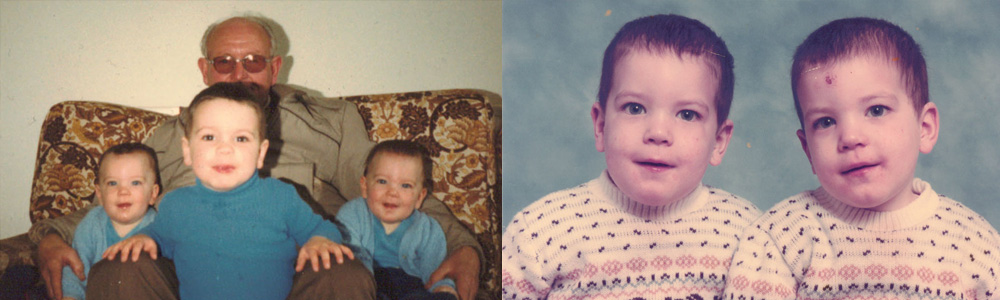

Our comparison was never intended as a formal experiment. It happened by accident. My twin was more concerned about his hair loss at the time than I was about mine, and he chose to act much sooner. I did not seriously look into treatment until years later. That delay created the contrast you now see in the photographs.
Even so, our story has value because we are monozygotic twins - identical twins with virtually identical DNA. That does not mean every variable in life is perfectly controlled, but it does make the comparison more unusual and more relevant than a typical before-and-after story involving unrelated people.
Before our hair loss paths separated more clearly, both of us appeared prone to Male Pattern Hair Loss. Our family history also points strongly in that direction. Early in the process, Twin A chose to use Dutasteride, while my own hair loss was allowed to progress untreated for years.
We also grew up in the same environment, shared many of the same habits and played sports regularly. No personal story can prove what will happen for everyone else, but our case does provide a rare real-world comparison.
Continuing on...
My twin brother and I were both predisposed to Male Pattern Hair Loss. For many men, hair loss can affect confidence and self-image, especially when it begins at a younger age than expected.
If you are experiencing Male Pattern Baldness, you may already have noticed thinning or recession beginning. In my own case, I had visible thinning in several areas before I eventually decided to act. My hope, when I later started treatment myself, was simply to hold on to more of what remained for longer.
Male Pattern Baldness, also known as Male Pattern Hair Loss (MPHL), affects men at different ages and progresses differently from person to person. Many men first notice it in their twenties or thirties, often when they suddenly realise that hair which once looked full and healthy is beginning to thin.
Below you can also see that it runs in our family. Our father lost his hair at a young age, and our older brother has also experienced Male Pattern Hair Loss.
I first started to notice hair loss in my early twenties after workmates pointed out a thinning patch on the crown of my head. Where I had once had a full head of hair, the crown began to look weaker and thinner. I knew something was changing, but instead of confronting it, I largely ignored it for a long time. My twin took the opposite approach and addressed it much earlier.
That is one of the biggest lessons from our story: once hair loss becomes more advanced, managing it can become more difficult. Early action may matter, but individual results, tolerance and progression can vary significantly from one person to another.
Why early attention can matter
- Many men begin noticing signs of balding relatively young, sometimes even in their twenties.
- In general, maintaining existing hair tends to be easier than trying to restore hair that has already been lost.
- In our case, Twin A started treating his hair loss at an earlier stage, and over time he retained much more of his hair than I did.
Important Notice: This website does not provide medical consultation or treatment advice. I am sharing our personal experience only. If you are considering Dutasteride, Finasteride or any other treatment, please consult your doctor or another qualified medical professional and read our full disclaimer.
What I can say with confidence is that this website documents a clear visual contrast between me and my twin over many years. The photographs show what happened in our case. They should be viewed as a personal case study, not as a guarantee of what any particular treatment will do for someone else.
If you would like to see more, browse the full gallery and compare the photos for yourself.